Cotton vs Polyester for Kids: Comfort, Care and Climate
A practical, parent-friendly guide to choosing playful prints without compromising on comfort, fit or everyday wear.
Practical choices.
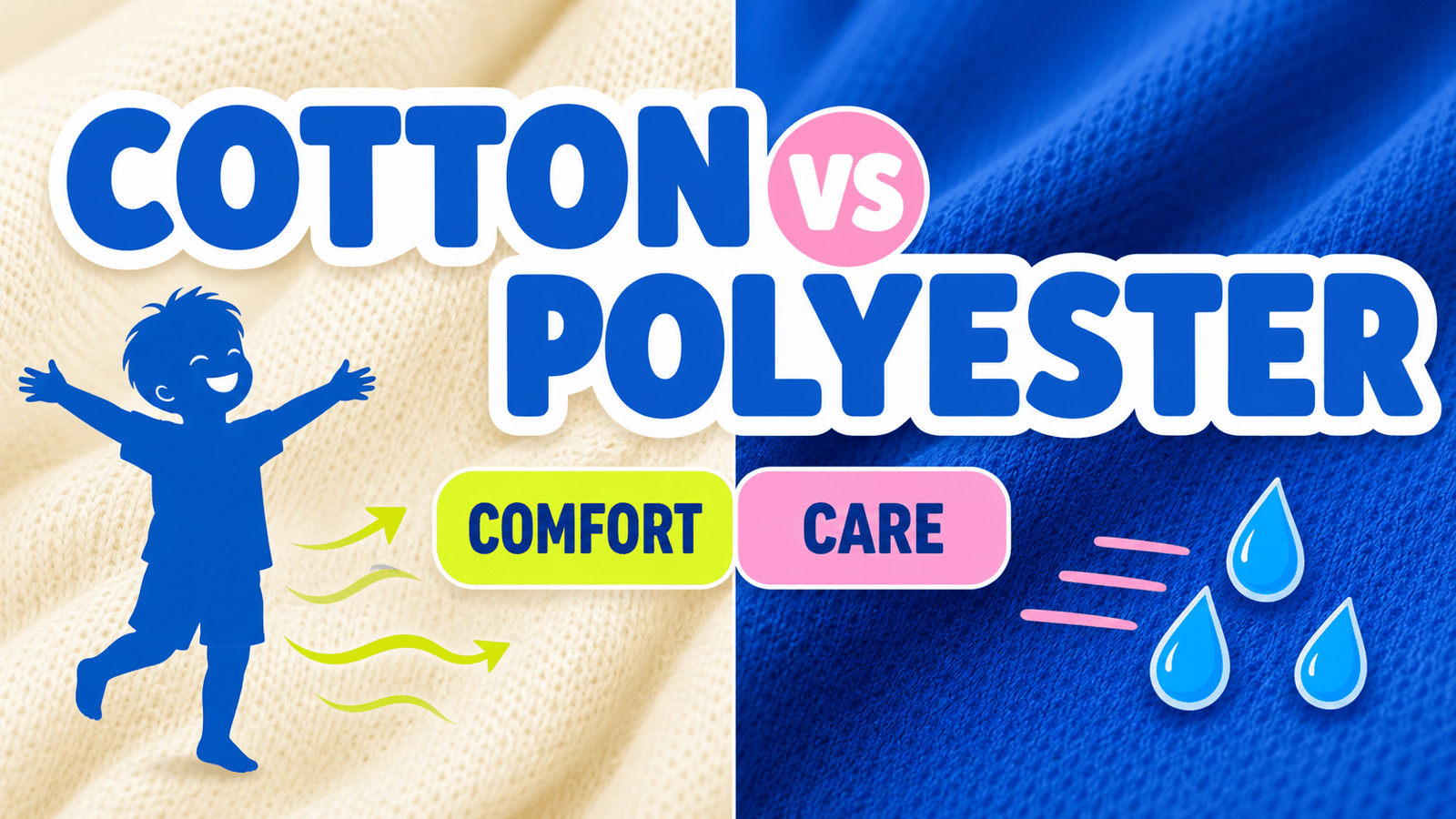
Neither cotton nor polyester is automatically best for every child or every use. Cotton is generally more absorbent, while polyester is generally quicker-drying, wrinkle-resistant and abrasion-resistant. Fabric weight, knit or weave, fit, finishing, seams and care can matter as much as the fibre name. Read the exact composition and care label instead of choosing from “cotton” or “polyester” alone.
A blend can combine characteristics of two fibres, but a percentage still cannot predict the whole garment. This guide compares the practical trade-offs parents can check when buying everyday kids clothes online.
Cotton vs polyester: quick comparison
| Question | Cotton | Polyester |
|---|---|---|
| Moisture | Generally absorbent | Generally low absorbency and quicker-drying |
| Wrinkles | Can wrinkle more unless treated or blended | Usually more wrinkle-resistant |
| Abrasion | Depends strongly on fabric construction | Generally good abrasion resistance |
| Heat during care | Can tolerate different care depending on dye and finish | Heat-sensitive; follow the label for drying and ironing |
| Shrinkage | Can shrink if fabric or care is not controlled | Usually more dimensionally stable |
| Best choice | The fabric and garment that suit the activity, climate, child and care routine | |
The fibre summaries above align with a University of Georgia Extension textile reference, which compares cotton and cotton-polyester clothing by absorbency, construction and care. Individual fabrics can behave differently, so the product label remains the final source for composition and care.
1. Start with the activity, not the marketing word
A child sitting in an air-conditioned room, playing outdoors, travelling, sleeping or attending an event may need different clothing. Ask:
- How much movement will the garment need to allow?
- Is the environment hot, humid, cool or strongly air-conditioned?
- Will the garment be washed frequently?
- Does your household line-dry, machine-dry or iron most clothes?
- Does the child object to a particular seam, label or surface feel?
The fibre content informs the decision, but it does not replace trying the garment or checking construction.
2. Compare moisture behaviour carefully
Cotton fibres are absorbent. Polyester fibres generally absorb less moisture and can dry quickly. That does not mean every polyester fabric “wicks” moisture or every cotton fabric stays comfortable in the same conditions. Wicking and drying performance depend on yarn, structure and finishing as well as fibre.
Be cautious with absolute claims such as “sweat-proof,” “keeps children cool” or “best for all summers” unless the brand provides suitable test evidence. For everyday shopping, look at fabric weight, openness, fit and the child’s activity alongside composition.
3. Look at fabric construction
Two fabrics with the same fibre percentage can feel and perform differently. A light knit, dense knit, brushed surface and woven fabric do not have the same airflow, stretch or drying behaviour. Product photography can show colour and print, but it rarely proves thickness or airflow.
Useful product information includes:
- Exact fibre percentages
- Knit or woven construction
- Fabric weight when available
- Stretch information
- Care temperature and drying instructions
- Close-up photographs of texture and seams
4. Compare comfort at seams and openings
Fibre choice cannot compensate for a tight neck, rough seam, restrictive armhole or waistband that twists. Run a hand along the inside of the garment when it arrives. Check the neck finish, underarm, side seams, waistband join and crotch seam before removing tags.
For an active set, ask the child to raise both arms, sit cross-legged, squat and take a long step. Our kids shorts-set guide gives a complete movement checklist.
5. Consider washing and drying
Cotton can shrink or change shape if exposed to unsuitable washing or drying conditions. Polyester is heat-sensitive and can retain oily stains or odours if they are not treated correctly. Printed garments add another variable: colour and print durability depend on dyes, inks, finishing and care.
Always follow the sewn-in care label. Wash similar colours together, treat stains promptly with a method suitable for the garment, avoid guessing at high temperatures and reshape items if the label recommends it.
6. Understand cotton-polyester blends
A cotton-polyester blend can be designed to balance absorbency, strength, wrinkle resistance and dimensional stability. The exact result depends on the ratio and construction. A 60/40 blend and a 95/5 blend are not interchangeable, and “cotton-rich” is not an exact percentage unless the composition is stated.
Do not assume a blend is inferior or superior. Compare the actual fabric to the use case and care routine.
7. Check claims for sensitive skin carefully
A fibre name alone cannot diagnose or prevent skin irritation. Dyes, finishes, seams, detergent residue, heat, fit and individual sensitivity can all matter. If a child has persistent irritation or a diagnosed condition, ask a qualified healthcare professional for advice and follow it over general clothing content.
For ordinary comfort checks, look for clear composition information, smooth internal construction, a non-restrictive fit and care instructions you can follow consistently.
8. Use a decision table
| Your priority | What to inspect |
|---|---|
| Everyday warm-weather play | Light fabric, relaxed movement, seam comfort, actual fibre composition |
| Quick turnaround after washing | Drying instructions, fabric weight, shape retention and household drying method |
| Low ironing | Wrinkle recovery, blend information and care label |
| Frequent active use | Abrasion points, stitching, wash routine and colour/print care |
| Child dislikes certain textures | Inside surface, seams, labels and openings—not fibre name alone |
How A Tiny Bee describes its garments
A Tiny Bee catalogue data tags many current shorts sets as cotton, including the Croc Splash Shorts Set. A catalogue tag should not be converted into a “100% cotton” claim unless the product page or sewn-in label states that percentage. Check the current product information and the garment label when it arrives.
Frequently asked questions
Is cotton always cooler than polyester?
No universal answer applies to every fabric. Fibre, weight, construction, finish, fit, airflow and activity all affect how clothing feels.
Does polyester dry faster than cotton?
Polyester generally has lower moisture absorbency and dries faster, but fabric thickness and construction can change real-world drying time.
Do cotton kids clothes shrink?
They can. Fabric preparation and washing, drying and ironing conditions affect dimensional change. Follow the garment’s care label rather than one rule for all cotton products.
Are cotton-polyester blends good for kids?
They can be useful when their particular balance of feel, durability, wrinkle resistance and care suits the child and activity. Check the exact percentages and construction.
Which fabric is best for sensitive skin?
There is no single best fibre for every child. Use composition, seam, finish and fit information, and seek professional advice for persistent or diagnosed skin concerns.
What should I check when comparing breathable kids clothes?
Do not use “breathable” as a substitute for product evidence. Compare the exact fibre percentages, fabric weight and structure, fit, layers, activity and expected conditions. A garment’s airflow and moisture behaviour cannot be proven from a fibre name or photograph alone.
What is the best material for kids clothes?
There is no universal winner. Compare the exact fibre percentages and fabric construction with the child’s activity, weather, fit needs, skin considerations and your care routine. A well-suited finished garment matters more than choosing from one fibre name alone.
Explore A Tiny Bee kidswear and verify the current composition, size, price and availability on each product page.
Bring the guide to life
Only currently available products are shown. Sizes and stock update live.