Kids Clothes Under ₹500: A Quality Checklist for Parents
A practical, parent-friendly guide to choosing playful prints without compromising on comfort, fit or everyday wear.
Practical choices.
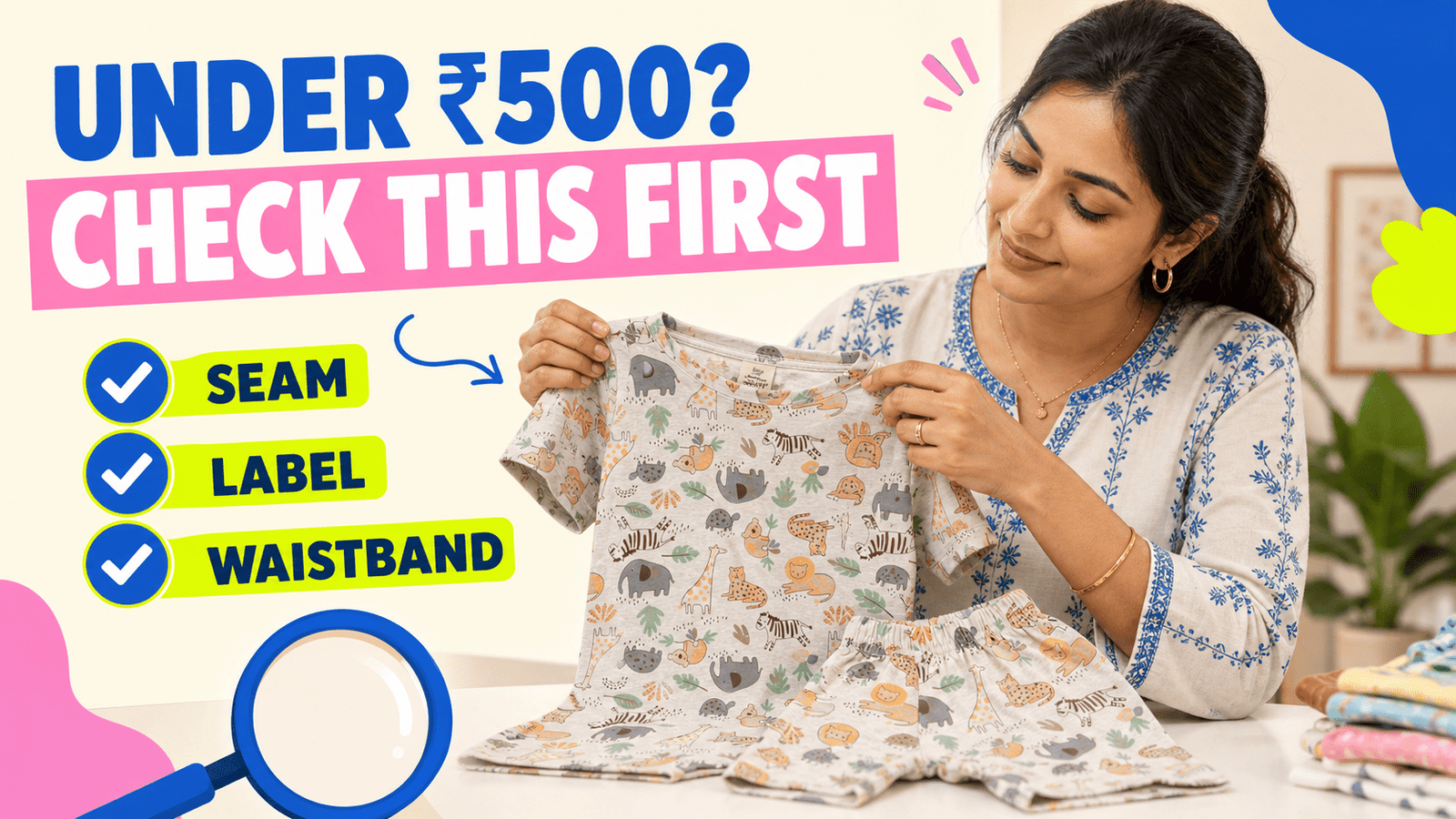
Good kids clothes can cost under ₹500, but price alone cannot tell you whether an item is good value. Check the material description, measurements, neckline, seams, waistband, print care, exchange terms and realistic cost per wear. A large discount percentage is less useful than clear product information and a garment that fits the child’s routine.
This checklist is designed for parents comparing affordable kidswear online in India. It focuses on details you can verify before ordering and immediately after delivery.
The 60-second product-page check
- Is the selling price clear? Note the final item price and any shipping or COD cost.
- Is the material identified? Do not convert “soft” into “100% cotton” unless the page or label says so.
- Is there a useful size guide? Age alone is not enough for every child.
- Are multiple product images available? Look for front, back, print and construction views where provided.
- Can you understand the exchange policy? Affordable does not mean risk-free if the size is wrong.
- Is current availability shown? Confirm the exact size rather than assuming the full range is in stock.
1. Compare the final checkout cost—not only the product price
An item listed below ₹500 may cross the budget after shipping or payment charges. Delivery offers, free-shipping thresholds and Cash on Delivery conditions can change, so use the cart and checkout as the current price source and read the live shipping policy before paying.
For a fair comparison, calculate:
Final cost = product price + shipping + payment charges − confirmed discounts.
2. Read claims literally
“Cotton,” “cotton-rich” and “100% cotton” are not interchangeable phrases. “Soft feel” is subjective. “Premium” has no standard definition on its own. Use the most specific information available and check the garment label after delivery.
A Tiny Bee’s current catalogue tags the featured shorts sets in this guide as cotton. It does not follow that every product on the internet—or even every product in one store—has the same composition. Product-level details should remain the source of truth.
3. Use measurements to reduce wrong-size purchases
A low price is not good value when the garment cannot be worn. Measure the child and compare the result with the current size chart. If measurements sit between sizes, consider the garment shape, the child’s proportions and the desired fit rather than automatically choosing the larger age label.
When the order arrives, try these movement checks before removing tags:
- raise both arms without the body riding up uncomfortably;
- sit, squat and take a long step without pulling at the crotch or thigh;
- check that the waistband stays in place without digging in;
- make sure the neck opening passes over the head comfortably.
4. Inspect construction in daylight
You do not need specialist equipment. Turn the garment inside out and look at the seams. Stitching should be reasonably even, seam ends should be secured, and there should not be long loose threads that pull the seam open. Check the underarm, crotch, waistband join and inner thigh because these areas move frequently.
Stretch the waistband gently and release it. It should recover evenly. Inspect printed areas for unintended marks or gaps, while remembering that normal placement can vary on an all-over print.
5. Calculate cost per wear
Cost per wear is a more useful value measure than discount percentage:
Cost per wear = final checkout cost ÷ number of actual wears.
| Final cost | Actual wears | Cost per wear |
|---|---|---|
| ₹300 | 3 | ₹100 |
| ₹400 | 10 | ₹40 |
| ₹500 | 25 | ₹20 |
The examples are calculations, not promises about durability. Actual wear count depends on fit, growth, care, construction and whether the child likes the garment.
For the complete calculation method, including mixed outfit use and outgrown garments, see our kidswear cost-per-wear guide. If your budget ceiling is lower, use the separate kids clothes under ₹300 checklist rather than treating a larger discount badge as proof of value.
6. Look for pieces that create more than one outfit
A co-ordinated set has an immediate advantage: the top and bottom already work together. Value improves if each piece also combines with clothes at home. A blue printed shorts set, for example, may separate into a printed T-shirt worn with neutral shorts and printed shorts worn with a plain white or green top.
The current Croc Splash Shorts Set is one example. When this article was prepared, it was listed at ₹289 and showed sizes 1–2 through 7–8 available. Check the live page because price and inventory can change.
7. Understand the exchange rules before ordering
Budget shopping still requires a fit-risk plan. A Tiny Bee’s current FAQ states that it offers exchanges rather than returns or refunds. Read the live Returns & Cancellation policy for eligibility, deadlines and process before placing an order. If a store’s policy is unclear, factor that uncertainty into the purchase decision.
What “under ₹500” should and should not mean
| A useful value signal | Not enough on its own |
|---|---|
| Clear material description | “Premium quality” badge |
| Measurements or usable size guide | Age label only |
| Visible construction and care information | Large discount percentage |
| Transparent final cost and policy | Low product price before checkout |
| Pieces that earn repeat wear | Trend value without wardrobe compatibility |
Frequently asked questions
Can a kids co-ord set under ₹500 be good quality?
Yes, it can meet a family’s needs, but the price does not prove quality. Verify material information, fit, construction, care and policy details, then inspect the delivered garment before removing tags.
Is a higher MRP discount always a better deal?
No. Compare the final checkout cost, product details and likely cost per wear. A discount percentage does not measure comfort or construction.
What should I check first when the garment arrives?
Confirm the ordered size and item, compare it with the product description, inspect seams and print in daylight, and test fit gently while keeping tags attached and following the exchange policy.
How can I make affordable kids clothes last longer?
Follow the garment label, wash only when needed, treat stains promptly, avoid unnecessary heat and rotate several everyday outfits rather than repeatedly wearing one.
Browse all A Tiny Bee kidswear and verify the current price, size availability and checkout charges before ordering.
Bring the guide to life
Only currently available products are shown. Sizes and stock update live.