Cotton Night Suits for Kids: What to Check Before Buying
A practical, parent-friendly guide to choosing playful prints without compromising on comfort, fit or everyday wear.
Practical choices.
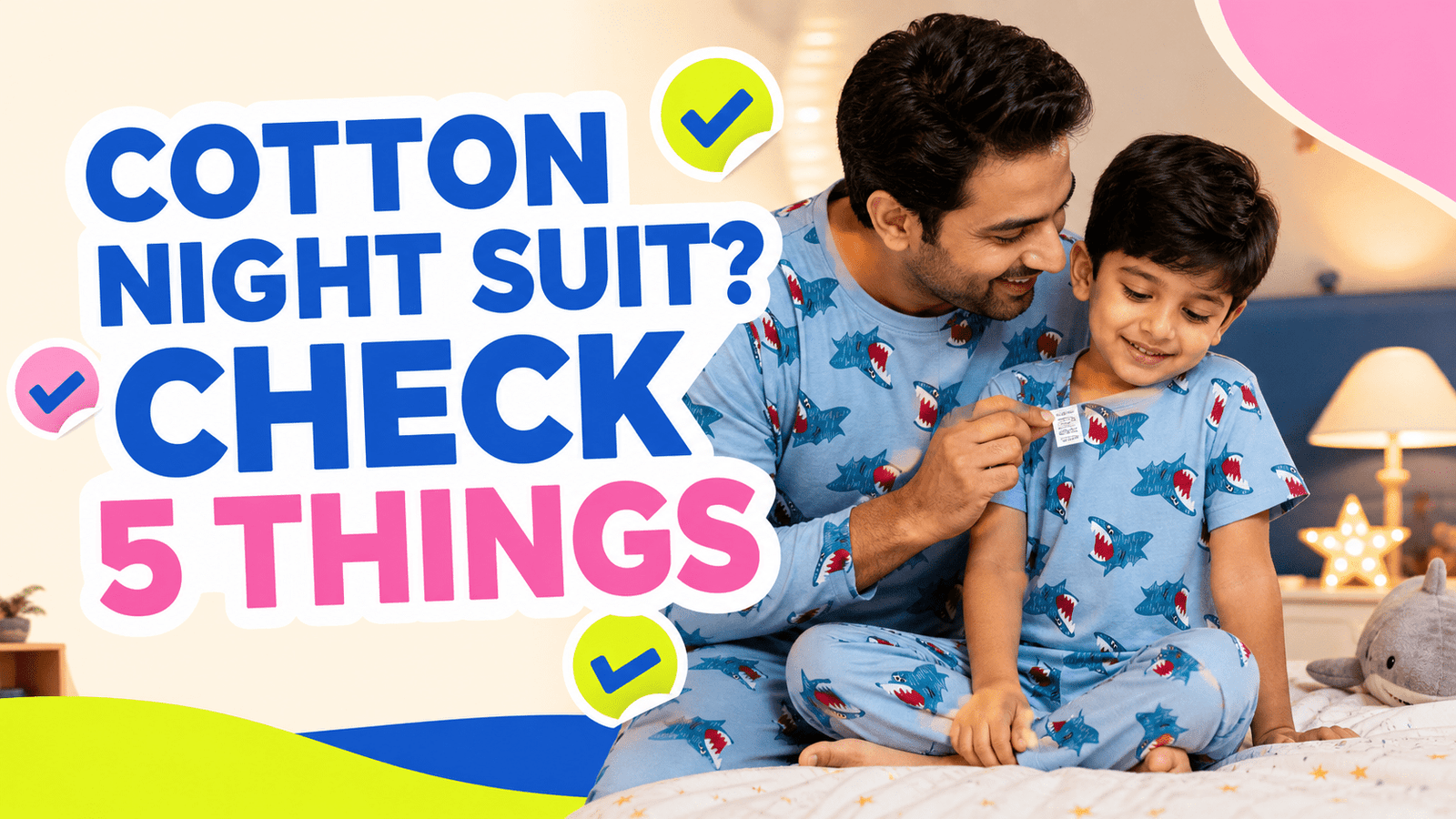
When buying a cotton night suit for kids, verify the composition claim, fabric weight, seams, waistband, fit and care label rather than treating “cotton” as a complete quality guarantee. Cotton can be made into different fabrics with different finishes, weights and wash behaviour. The right set is the one whose actual construction and measurements suit the child and room conditions.
This checklist helps parents compare product pages accurately and inspect the delivered garment before removing tags.
1. Identify the exact cotton claim
Read the words used on the product page and garment label:
- 100% cotton is a fibre-content claim.
- Cotton blend means cotton is combined with another fibre.
- Cotton feel describes feel and does not establish composition.
- Soft cotton combines a material reference with a subjective description; look for the exact percentage separately.
Do not turn a catalogue tag into a laboratory result. A Tiny Bee’s active pajama products are currently tagged “cotton” in the live catalogue; parents should still use the current product information and sewn-in label for the most precise composition and care instructions.
2. Consider fabric weight and construction
Two cotton garments can feel very different. A lighter knit can feel less substantial and may dry faster, while a heavier knit may feel more structured. Opacity, stretch and surface finish also affect the experience. Product photography cannot reliably show every one of these properties, so read the description and inspect the garment in daylight after delivery.
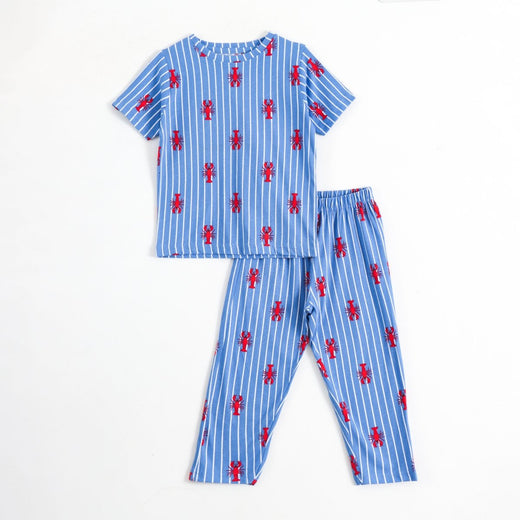
The current Lobster Stripe Pajama Set combines a short-sleeve top with full-length elastic-waist bottoms. It was listed at ₹349 in sizes 2–3 through 7–8 when this guide was prepared. The exact price and stock should be checked live.
3. Check fit at the neck, shoulder and arm
The neck opening should pass over the head comfortably. Shoulder seams should sit consistently, and the sleeve opening should not restrict an arm raise. Ask the child to reach forward and overhead; the body of the top should not pull sharply across the chest or ride up excessively.
Age is not a measurement. Compare the child’s height, chest, waist and hip with the brand’s current chart. A well-fitting top already at home can be measured flat as an additional reference.
4. Check the waistband and leg length
With the waistband sitting naturally, the child should be able to sit, squat and walk without pressure or slipping. Check the rise and seat as well as the waist. For full-length bottoms, confirm that the hem does not sit under the heel or create large folds around the ankle.
See our separate guide on how kids pajamas should fit for a complete movement test.
5. Inspect seams before removing tags
- Turn the garment inside out in good light.
- Check that seam lines are reasonably even and ends are secured.
- Look closely at the underarm, crotch, inner leg and waistband join.
- Check for long loose threads that affect the seam rather than harmless short trimming ends.
- Compare the received print and colour with the product description.
6. Follow the garment label when washing
The sewn-in care label should outrank generic internet advice. For printed cotton garments, families often reduce unnecessary abrasion by turning pieces inside out and avoiding excessive heat, but the product-specific instructions remain the source of truth. Wash the top and bottom together when practical so the pair experiences a similar number of cycles.
Do not promise “no shrinkage.” Cotton garments can change because of fibre, knit, finishing, water temperature, drying and handling. A precise seller should explain care rather than make an absolute claim without evidence.
7. Compare value using information, not adjectives
| Useful evidence | Weak evidence by itself |
|---|---|
| Specific fibre-content statement | “Premium” |
| Usable measurements | Age label alone |
| Clear care instructions | “Easy care” |
| Visible construction details | Discount badge |
| Transparent price and policy | “Best quality” |
8. Match coverage to the room, not the calendar
“Summer night suit” is a shopping label, but the child experiences the bedroom rather than the outdoor forecast. A room with strong air-conditioning can feel different from a naturally ventilated room on the same night. Compare short and long sleeves, shorts and full-length bottoms, and any separate layer according to the actual setting and the child’s preference. Avoid assuming that cotton fibre content alone determines warmth; fabric weight, construction and coverage also contribute.
If the room conditions change through the year, a simple base set plus a separate light layer can be more flexible than buying one heavy garment for every situation. Keep the layer easy to remove and assess the individual child rather than relying on a universal temperature rule.
Cotton night-suit arrival checklist
- Confirm that the product, colour and size match the order.
- Read the fibre and care labels.
- Inspect seams, waistband and print in daylight.
- Test head opening, arm movement, sitting and walking with tags attached.
- Check the exchange window before washing.
- Keep order records until the fit is settled.
Frequently asked questions
Is 100% cotton always better for kids pajamas?
Not automatically. Fibre content is only one factor. Fit, fabric construction, room conditions, care and the individual child’s preference also matter.
How can I tell whether a night suit is really cotton?
Use the product’s fibre-content statement and the sewn-in garment label. Touch alone cannot establish an exact percentage.
Do cotton kids pajamas shrink?
They can change depending on the fabric and care process. Follow the label and avoid unsupported absolute claims. If post-wash measurements are important, ask the seller whether its size chart refers to pre-wash or finished garment dimensions.
Are short sleeves suitable for a cotton night suit?
They can suit some children and rooms. Choose coverage according to the actual room temperature and the child’s comfort rather than the season name alone.
Read the broader kids night-suit buying guide, or browse A Tiny Bee pajama sets for current details.
Bring the guide to life
Only currently available products are shown. Sizes and stock update live.