How to Stop Cotton Clothes Fading: A Label-First Guide
A practical, parent-friendly guide to choosing playful prints without compromising on comfort, fit or everyday wear.
Practical choices.
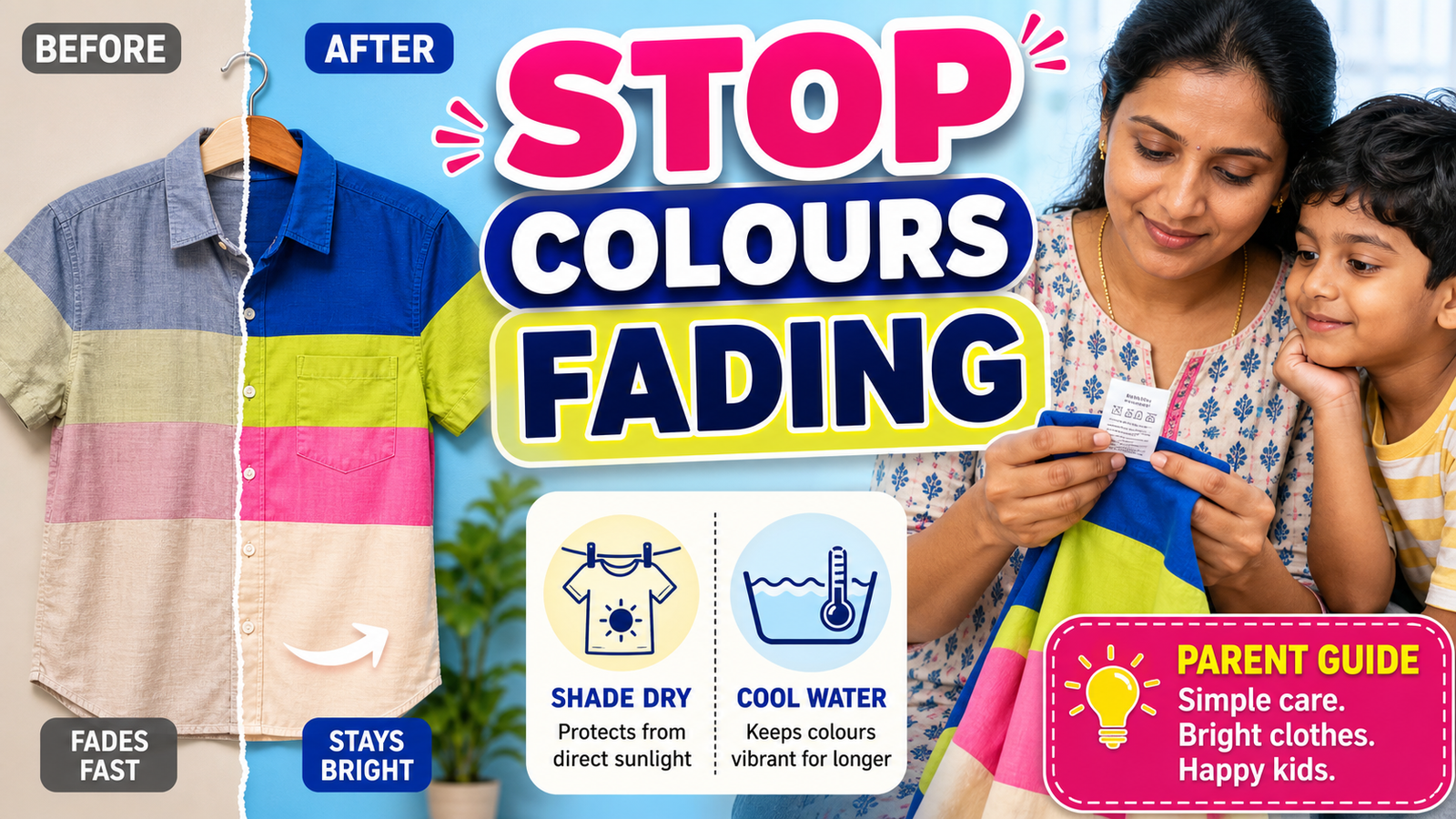
You cannot guarantee that cotton clothes will never fade. You can reduce avoidable colour and print loss by following the exact care label, separating items as instructed, using a suitable detergent dose and cycle, avoiding unapproved bleach or heat, and drying the garment by the stated method.
“Cotton” describes a fibre, not the colourfastness of every dye, print, finish or trim. Two cotton garments can respond differently because their dyes, construction and care instructions differ.
First identify the colour problem
| Problem | What it looks like | What to check |
|---|---|---|
| Dye transfer | Colour moves onto another item or wash water | Separate/like-colour warning and colourfastness |
| General fading | The garment becomes progressively lighter | Temperature, chemistry, friction, drying and exposure |
| Print damage | Surface graphic cracks, peels or abrades | Inside-out instruction, ironing warning and mechanical action |
| Patchy colour loss | Local pale marks or spots | Undiluted product, splash, stain treatment or rubbing |
These problems do not have one universal remedy. A step that is safe for one dye or finish may harm another.
1. Read every part of the care instruction
Check washing method, permitted water temperature, drying, bleaching, ironing and warnings. The US Federal Trade Commission’s care-label guide explains that warnings may include “wash with like colors” or “wash separately” when a product could harm another item.
The FTC rule applies to products under US jurisdiction, not as an Indian legal rule for A Tiny Bee. It is used here as transparent educational context for reading complete garment-care instructions.
2. Separate by the label and colour risk
Do not place a new, strongly coloured item into a pale load merely because every garment is cotton. Follow any separate-wash or like-colour warning. Check pockets and remove items that could rub, leak or snag.
If colourfastness is uncertain before stain treatment, test the planned product on a concealed area. The University of Georgia textiles guidance repeatedly recommends checking the care label and pretesting questionable colours. Its laundry-products reference also warns that undiluted bleach should not be applied directly to fabric.
3. Use the permitted temperature and cycle
Do not convert “cold,” “warm” or “machine wash” into a different setting based on a social-media hack. Follow the label and the washer instructions. Select a cycle that cleans the actual soil without unnecessary mechanical action.
Turn a printed garment inside out only when that is compatible with its care instructions and closures. This can place the decorated surface away from some direct rubbing, but it is not a promise against fading.
4. Measure detergent and laundry additives
Use the detergent instructions for load size, soil level, water conditions and machine type. More product is not automatically more protective. Do not pour concentrated products directly onto a coloured garment unless the product and care instructions explicitly permit it.
Bleach is not one interchangeable category. If the garment says no bleach, do not use it. If a specific non-chlorine option is allowed when needed, follow that wording and the product label. Never mix chlorine bleach with ammonia or other incompatible cleaners.
5. Treat stains without creating pale spots
Remove excess material carefully, identify the stain and pretest the treatment. Repeated hard rubbing can change the surface even when the stain remains. Do not dry a garment until a heat-sensitive stain has been assessed, because some stains can become harder to remove.
Use the cautious workflow in how to remove stains from kids clothes rather than applying vinegar, salt, baking soda, bleach or another household product to every colour problem.
6. Dry and iron exactly as directed
Follow the stated drying method and temperature. Do not assume strong direct sun or the highest dryer setting is suitable for every cotton print. Remove the garment when dry instead of leaving it through extra heat or weather exposure.
Check the ironing instruction. A surface print may require a lower temperature, inside-out ironing or no direct iron contact. If the label does not answer an important question, ask the seller rather than experimenting on a visible area.
7. Record change instead of guessing
Before the first wash, view the garment in neutral daylight and photograph a small repeatable area. Compare the same area after several correctly completed washes. This separates ordinary gradual change from one accidental patch, transfer event or print failure.
Do not judge colour only from two phone photographs taken under different lighting. Use the same location, exposure and garment orientation where practical.
What to do after fading occurs
The University of Georgia textiles resource states that once fading occurs, the original colour cannot be restored. Stop and identify the cause before the next wash. Check for concentrated product marks, incompatible bleach, dye transfer, excessive heat or an incorrect care method.
Re-dyeing a finished kids garment can affect thread, trims, prints and labels differently and is not a universal home fix. Continue using a safely wearable garment if appropriate, repurpose it, or seek qualified textile advice.
Frequently asked questions
Does cold water always stop cotton clothes fading?
No. Use the permitted temperature on the exact care label. Dye, print, chemistry, friction and drying also affect appearance.
Should I add vinegar or salt to set the colour?
Do not use a universal household hack. It may be unnecessary, ineffective or incompatible with the garment or machine. Follow the care and product instructions.
Should printed clothes be washed inside out?
It may reduce some direct surface rubbing when compatible with the care instructions, but it cannot guarantee that a dye or print will not change.
Can I use bleach on coloured cotton?
Only when the exact care label and bleach product permit the specific use. Pretest when required and never apply undiluted bleach directly or mix incompatible chemicals.
Can faded colour be restored?
Not reliably to the original state. Identify and correct the care problem to reduce further avoidable change.
For the complete wash sequence, read how to wash cotton kids clothes. Then explore current A Tiny Bee kidswear and follow the exact garment’s sewn-in care label.
Bring the guide to life
Only currently available products are shown. Sizes and stock update live.