Kids Clothing Size Chart India: How to Read One Correctly
A practical, parent-friendly guide to choosing playful prints without compromising on comfort, fit or everyday wear.
Practical choices.
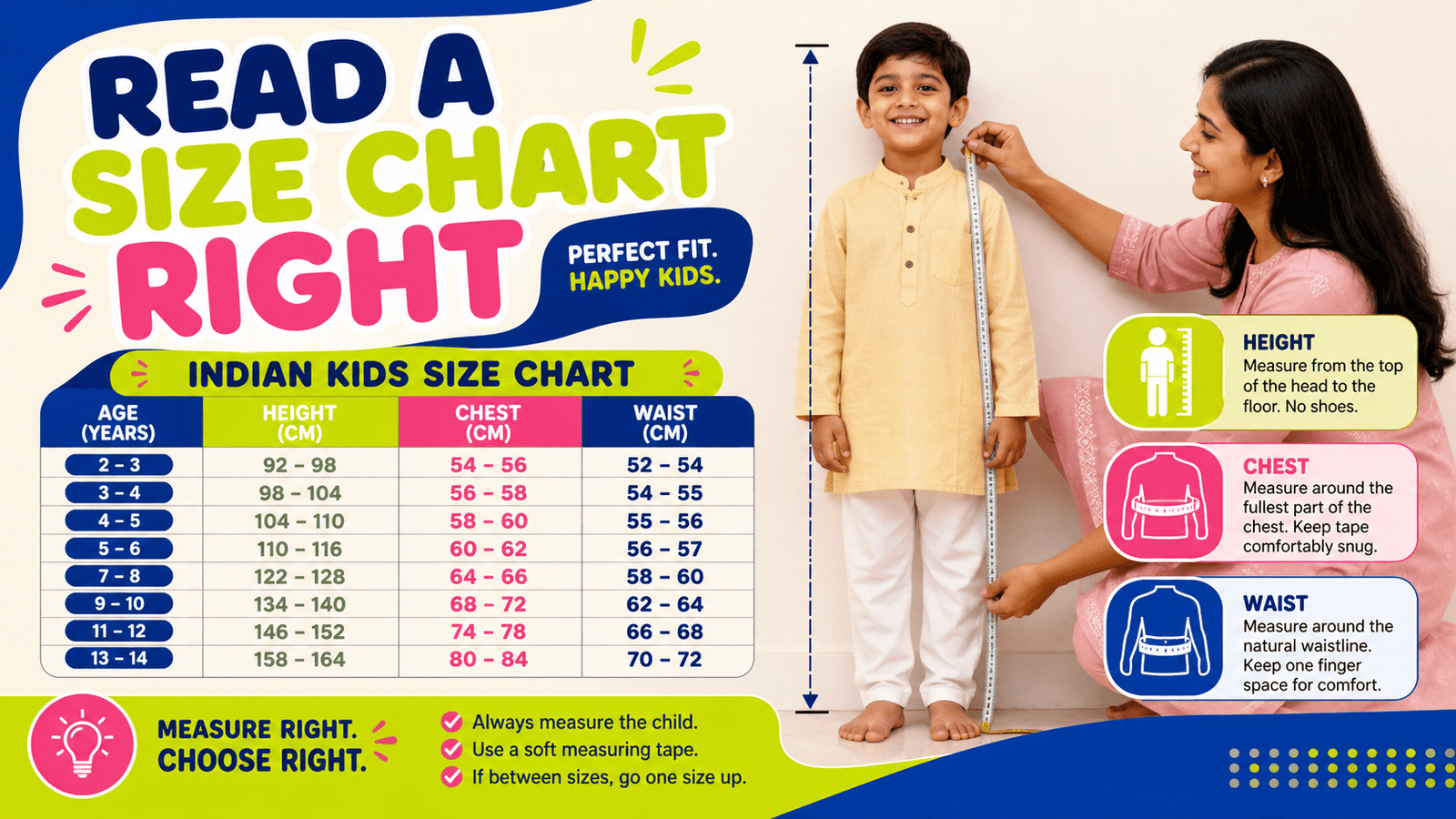
A kids clothing size chart in India should be read as a brand-and-garment-specific tool, not as a universal conversion from age to size. First identify whether the numbers describe the child’s body or the finished garment. Then compare the relevant current measurements and allow for the ease built into that exact style. An age label such as 4–5 is a starting category, not proof of fit.
This guide is about interpreting a chart after you have measurements. For the measuring process itself, use our five-minute kids clothing measurement guide.
There is no single universal India chart
Different brands can build different proportions and ease into the same age-labelled size. A relaxed T-shirt, a fitted pajama top and a gathered frock can all carry “4–5” while having different chest, shoulder and length measurements.
The ISO 8559-3 overview explains that body-measurement tables are created for defined population groups and that body shapes and proportions within a population differ. It also explicitly distinguishes body-measurement tables from finished-garment dimensions. That distinction is the most important part of reading any retail chart.
A Tiny Bee size labels at a glance
This catalogue snapshot was checked on . It shows the age labels configured for each A Tiny Bee product type; it is not a body-measurement conversion chart. Stock still varies by design, so use the selector on the exact product page before ordering.
The dated methodology and machine-readable CSV/JSON downloads are published in the A Tiny Bee Catalogue Availability Snapshot — July 2026. Cite those figures only as an A Tiny Bee catalogue snapshot, not as India-wide sizing or market evidence.
| Product type | Configured age labels | Full-size-run designs in stock |
|---|---|---|
| Shorts sets | 1–2, 2–3, 3–4, 4–5, 5–6, 6–7 and 7–8 | 32 of 68 active designs |
| Pajama sets | 2–3, 3–4, 4–5, 5–6, 6–7 and 7–8 | 3 of 3 active designs |
| Frocks | 2–3, 3–4, 4–5, 5–6, 6–7 and 7–8 | 10 of 10 active designs |
“Full size run” here means every configured age-labelled variant for that design had positive sellable inventory at the time of the check. It does not mean every label fits every child, and it does not guarantee later availability.
Step 1: identify what the chart measures
| Chart type | What the number describes | How to compare |
|---|---|---|
| Body measurement | The child’s chest, waist, hip, height or another body dimension | Compare with the child’s current measurement taken the same way |
| Garment measurement | The finished top, bottom, frock or pajama laid flat or measured around | Compare with a similar garment that fits, then account for measurement method |
| Age label only | A category chosen by the brand | Use only to narrow options; find measurements before deciding |
If the chart does not say “body” or “garment,” ask the seller. Do not subtract or add ease until the chart type is clear. Also check whether widths are measured flat: a flat chest width is not the same number as a full chest circumference.
Step 2: find the controlling fit point
Not every measurement has equal importance for every garment. Start with the dimension most likely to stop the garment from functioning.
- Tops: neck opening, chest and shoulder usually deserve attention before hem length.
- Shorts and pajama bottoms: waist, rise, hip/seat room and leg length affect wearability.
- Frocks: chest, shoulder, armhole and total length may control fit; the gathered skirt can have more room than the bodice.
- Two-piece sets: check top and bottom separately. One size must work for both pieces.
A child can match one size at the chest and another at the height. That does not make the chart wrong; it means you need the style’s controlling measurement and an honest trade-off. Our size-by-height guide explains when height helps and when it is insufficient.
Step 3: understand ease
Ease is the difference between a body measurement and the room designed into a garment. Some ease is needed for movement and dressing, but more is not automatically better. Excess length can bunch, twist or create a trip risk, while a very loose neck or waist may not stay in place.
Do not compare a finished-garment chest directly with a body chest and expect the numbers to match. Likewise, do not add a random number of centimetres to every style. The intended silhouette, fabric behaviour and opening all matter.
What common chart fields mean
| Field | Question to ask | Typical error |
|---|---|---|
| Chest | Is this circumference or flat width? | Comparing half-width with full circumference |
| Waist | Is elastic measured relaxed, stretched or around the body? | Assuming every elastic waist has the same stretch |
| Length / HSP | Where does the tape start and end? | Comparing centre-back length with high-shoulder-point length |
| Shoulder | Is it seam to seam across the back? | Using arm span or sleeve measurement instead |
| Rise | Is it front rise, back rise or total crotch measurement? | Ignoring seated and toilet-access comfort |
| Sleeve | Is it from shoulder seam, neck or centre back? | Mixing measurement methods |
Government of India training material from Bharat Skills discusses representative sizes and the differences in children’s proportions; see the lesson on children’s wear and measurement. A drafting reference can explain terms, but the current seller’s exact chart remains the correct shopping source for that product.
How to use these labels on A Tiny Bee
The snapshot above shows the active catalogue range, not a promise that every design or size remains in stock. Treat the age label as a filter, then verify the exact garment chart and variant availability.
Open the exact product page, choose the size selector and read the chart provided for that product type. Stock and garment details can change, so do not copy a size from another print or an old screenshot.
A reliable chart-reading sequence
- Confirm product type and intended fit.
- Check whether the chart uses body or garment measurements.
- Confirm centimetres versus inches and flat width versus circumference.
- Compare the controlling measurement first.
- Check opening, shoulder, rise and length as relevant.
- If between sizes, state the trade-off instead of automatically sizing up.
- Recheck the exact variant’s stock before checkout.
For the last decision, use our current-size versus next-size guide. It separates genuine growth room from an oversized fit that may interfere with use.
Frequently asked questions
Is there one standard kids clothing size chart for India?
No single retail chart should be assumed to fit every brand and garment. Use the chart supplied for the exact product and confirm whether it shows body or garment measurements.
Does size 4–5 fit every four-year-old?
No. Age is a category, while children’s height and proportions vary. Compare current measurements and the intended fit.
Should I choose size by height or chest?
Use the measurement that controls the exact garment, then check the others. Height can guide length, while chest or waist may control whether the garment can be worn.
What does HSP length mean?
It commonly means length measured from the high shoulder point, but confirm the chart’s diagram because start and end points can vary.
Should I size up if my child is between sizes?
Not automatically. Compare which dimension is between sizes, the garment’s ease, opening and length, then decide which trade-off is safer and more usable.
Browse current A Tiny Bee size options and verify the exact product chart and live variant stock before ordering.
Bring the guide to life
Only currently available products are shown. Sizes and stock update live.