Clothes for a Sensory-Sensitive Child in India: A Practical Guide
A practical, parent-friendly guide to choosing playful prints without compromising on comfort, fit or everyday wear.
Practical choices.
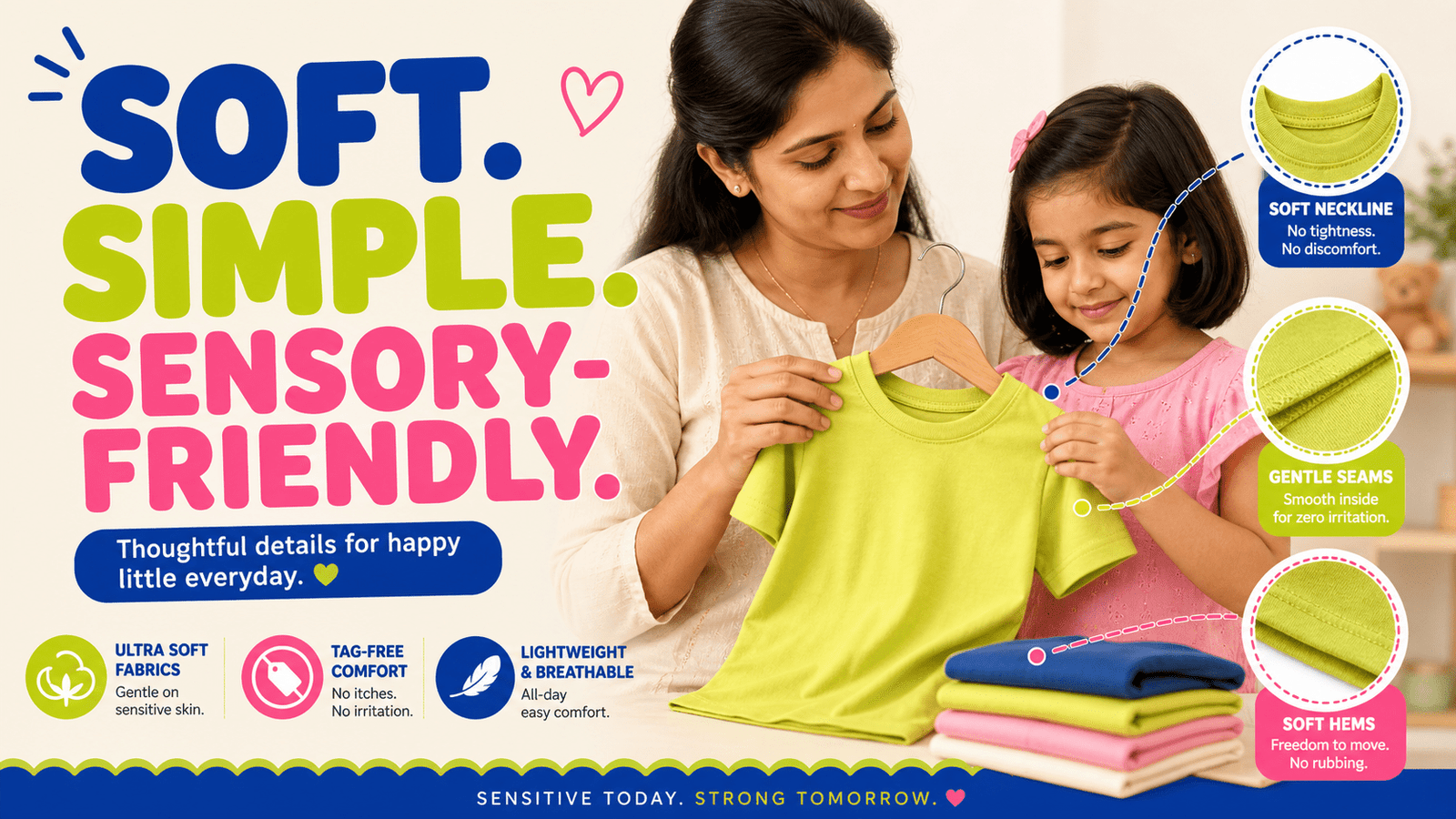
There is no single fabric, fit or brand that works for every sensory-sensitive child. Start with the child’s own observed preferences, inspect the exact garment for texture, seams, labels, waist sensation, sleeve length, fasteners, sound and smell, and test one item before buying multiples. “Sensory-friendly” should not be treated as a medical guarantee.
This guide is a clothing-selection framework, not a diagnosis or treatment plan. Sensory preferences can vary by child, body area, activity, weather and day. Skin pain, a persistent rash, sleep disruption or severe distress deserves advice from an appropriate health professional.
Build a preference profile before shopping
Look at garments the child already accepts and rejects. Record specific features rather than broad labels such as “fussy” or “only cotton.”
| Feature | Questions to observe | Evidence to take shopping |
|---|---|---|
| Surface feel | Smooth, brushed, crisp, slippery or textured? | A tolerated garment for comparison |
| Seams and labels | Which body areas are sensitive? | Photos of acceptable seam placement |
| Pressure and fit | Close, relaxed or variable by activity? | Current body and garment measurements |
| Openings | Is pulling clothing over the head difficult? | Preferred neck and armhole style |
| Length | Are sleeves, hems or socks a trigger? | Preferred lengths measured flat |
| Sensory extras | Do prints, fragrance, rustling or fasteners matter? | A short avoid/prefer list |
The NHS Humber Sensory Processing Hub explains that tags, seams and clothing textures may be irritating or painful for children with an over-responsive touch system. Its dressing guidance recommends involving the child, considering sleeve and trouser length, pre-washing when texture is an issue and using unscented detergent when smell is a trigger. These are options to test, not rules that every child must follow.
Inspect the exact garment, not just the fibre name
Two garments with the same fibre description can feel different because of yarn, knit or weave, weight, finish, seams, print backing, elastic and wash history. A product title cannot tell you how the complete item feels against a particular child.
Check front, back and inside photographs. Ask the seller for information that is missing rather than assuming a garment is seamless, tagless or soft. Our cotton clothing quality guide explains how to separate fibre disclosure from construction evidence.
Check seams, labels and print backing
Turn the garment inside out during inspection when the return policy allows handling. Look for bulky joins, loose thread ends, rough overlocking, a stiff label edge and thick decoration backing. A large external print may look smooth on the front while its reverse feels different.
Do not remove labels, cut seams or wash the item until you understand the return conditions. Altering a garment can make it non-returnable. If a label is a known trigger, first confirm that it can be removed cleanly without leaving a sharper edge or damaging the seam.
Treat elastic as a sensation, not a guarantee
Some children prefer close pressure; others reject it. Elastic can feel secure at one tension and uncomfortable at another. Check waistband width, casing, seam placement, rise and recovery, then compare the garment measurement with a tolerated item.
Do not choose an oversized garment automatically. Excess fabric can twist, bunch or interfere with movement. Use our elastic waistband fit checklist for construction checks, but let the child’s observed preference control the decision.
Plan the dressing process as well as the outfit
A suitable garment can still be difficult during a rushed or unpredictable routine. Offer a limited choice between pre-inspected options, prepare the outfit in advance, and allow time to notice whether the problem is the garment, the room temperature or the dressing sequence.
Front-and-back cues, large openings and simple fasteners may support dressing independence, but the preferred feature differs. Avoid forcing a child to tolerate an item simply because the size label is correct or another child accepts it.
Use online evidence carefully
- Compare the exact listing with the preference profile.
- Read fibre, care, size and return information.
- Ask for inside construction details if they are not shown.
- Buy one item before ordering the same style in several colours.
- Keep packaging and tags until the unwashed inspection is complete.
A seller’s words “comfortable,” “soft” or “sensory-friendly” are not substitutes for a child-specific trial. Our online kidswear buying checklist covers live variant stock, checkout cost and policy evidence.
Separate sensory preference from skin symptoms
A child may reject clothing because of touch, pressure, smell, heat, a skin condition or several factors together. Do not diagnose the cause from an outfit reaction. Visible inflammation, broken skin, persistent itching or pain should be discussed with a paediatrician or dermatologist.
HealthyChildren.org, from the American Academy of Pediatrics, provides separate clinical guidance for childhood eczema. Eczema advice should not be applied as proof that a garment is suitable for every sensory-sensitive child.
If irritation, eczema or another visible skin symptom is the main concern, use our separate kids clothes for sensitive skin checklist. That page covers fibre labels, seams, tags, heat, sweat and clinician-led care; this page remains focused on sensory preferences such as texture, pressure, sound and smell.
Create a small, reliable rotation
Once one style is accepted through ordinary wear and laundering, record its size, flat measurements, construction details and care method. A small rotation of known options can reduce rushed decisions. Recheck fit as the child grows rather than assuming the same labelled size will remain tolerable.
Frequently asked questions
What are the best clothes for a sensory-sensitive child?
The best option is the one that matches that child’s observed preferences and passes an exact-garment trial. There is no universal fabric or fit.
Are cotton clothes always sensory-friendly?
No. Fibre content does not reveal finish, seams, labels, print backing, elastic or fit, and children can respond differently to the same garment.
Should sensory-sensitive children wear loose clothes?
Not automatically. Some children prefer relaxed clothing and others prefer close pressure. Compare both with the child’s demonstrated preference and safe movement.
Should I remove every clothing label?
Only when the label is a trigger and removal will not leave a rough edge or damage the garment. Check return terms before altering a new item.
When should I seek professional advice?
Seek appropriate help when clothing distress is severe, persistent or disrupts daily life, or when there is pain, a rash, broken skin or another health concern.
Browse current A Tiny Bee styles as ordinary garment options, then verify each exact product against the child’s own preference profile.
Bring the guide to life
Only currently available products are shown. Sizes and stock update live.