Monsoon Clothes for Kids in India: A Practical Guide
A practical, parent-friendly guide to choosing playful prints without compromising on comfort, fit or everyday wear.
Practical choices.
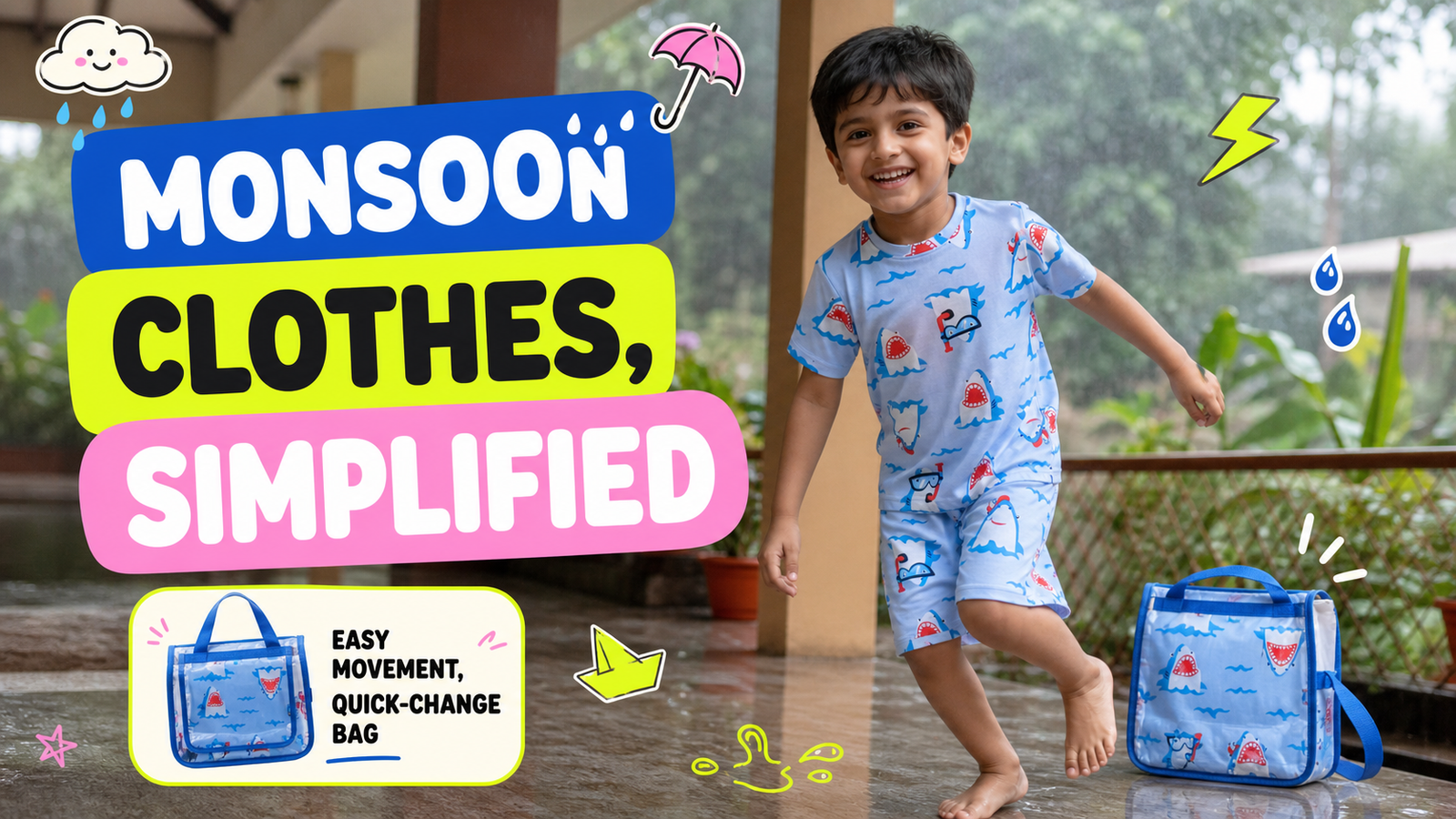
For monsoon weather in India, choose a secure, movement-friendly outfit that suits the current temperature and can be changed quickly if it becomes wet. Carry one complete dry change in a water-resistant inner bag. Check the local forecast, route and activity rather than treating every rainy day or city the same.
“Quick-dry” should not be assumed from a fabric name or marketing image. Drying time depends on fibre content, fabric thickness, construction, airflow and humidity. Verify the product information and test your household routine.
Check the day before choosing the outfit
- Rain timing: a brief shower and prolonged heavy rain need different preparation.
- Temperature and humidity: rain can arrive on a warm day or with a cooler wind.
- Route: consider walking, school transport, car travel and exposed waiting areas.
- Activity: indoor school, outdoor play and a family event have different movement needs.
- Changing access: know whether a dry place and caregiver help are available.
- Local warnings: follow current official instructions during severe weather or flooding.
Clothing is not protection against hazardous water, lightning, flooding or unsafe travel. Avoid risky routes and follow local authorities when conditions are severe.
A practical monsoon outfit formula
| Situation | Starting outfit | Carry separately |
|---|---|---|
| Warm, mostly indoor day | Light current-size top and shorts or suitable co-ord | One complete dry change |
| Cooler rain or strong indoor air-conditioning | Comfortable base outfit | Appropriate light layer + dry change |
| Long commute | Easy-change coordinated pieces | Dry outfit, socks if used, and wet-item bag |
| Outdoor event | Activity-appropriate clothing | Weather protection required by the venue + dry change |
This is a planning framework, not a universal prescription. Age, mobility, destination rules, weather and the child’s usual comfort all matter.
Choose fit before fabric slogans
Check the neck opening, shoulders, sleeve room, waistband, rise and hems. The child should be able to raise arms, sit, squat and walk without the outfit pulling or slipping. Avoid hems that drag or collect water.
Loose does not mean oversized. Very large necklines or waists can move out of place, while tight clothing may feel restrictive when damp. Use current measurements and the live product chart with our kids clothing measurement guide.
Understand drying time realistically
A thinner garment may dry faster than a thicker one under the same conditions, but fibre, knit or weave, print, elastic, airflow and humidity all change the result. Do not promise that cotton, polyester or a blend will always dry fastest without product-specific evidence.
At home, observe how a garment behaves after its permitted wash method in your actual drying space. Keep wet clothing away from the clean change and remove it from a sealed travel bag as soon as practical.
Pack one complete change, not random spare pieces
A spare top is not enough if the bottom becomes soaked. Pack a complete current-size outfit and any essential underlayer together. A coordinated set makes it easy to confirm that both pieces are present, but each piece should still fit properly on its own.
- Place the dry outfit inside a water-resistant inner bag.
- Carry a separate reusable bag for wet garments.
- Label school or childcare changes clearly.
- Check the spare monthly because children grow.
- Replace the spare after use instead of leaving the bag empty.
For longer journeys, use the quantities in our kids vacation clothing checklist rather than multiplying “just in case” items without a plan.
Separate rain protection from the base outfit
A raincoat, umbrella or other outer protection has a different purpose from the clothing underneath. Choose age-appropriate equipment for the route and supervise its use. Check that any outer layer does not block movement, vision or safe use of a school bag.
Do not use clothing choices to justify travel through waterlogged or restricted areas. Severe-weather decisions come before styling decisions.
Footwear needs its own check
Choose footwear appropriate to the surface, activity and destination rules. Check current fit, secure fastening and the child’s ability to walk safely. A material being waterproof does not guarantee grip, and a familiar shoe may still become unsuitable as the child grows.
When socks are part of the routine, pack a dry pair with the clothing change. Do not keep a child in wet socks or footwear longer than necessary; change and dry items according to their instructions.
Wash and dry according to the garment
Rainwater, mud and splashes do not make every garment suitable for the same wash. Check the sewn-in label, separate colours when instructed and pre-treat marks cautiously. Avoid sealing damp clothing for extended periods.
Use our kids clothing stain guide for a careful process. Do not mix cleaning products, and keep them away from children.
Build a small monsoon rotation
Plan enough everyday outfits for the household’s real wash-and-dry cycle, including slower drying during humid weather. Count only garments that fit, are suitable for the current routine and can return to use as expected.
Do not buy a separate “monsoon wardrobe” automatically. Start with current clothes, identify the actual drying or changing gap, and fill only that gap. The kids wardrobe quantity calculator can help.
Frequently asked questions
What should kids wear in the monsoon in India?
Start with a current-size, movement-friendly outfit suited to the day’s temperature and activity. Carry one complete dry change and follow local weather warnings.
Is cotton good for the rainy season?
Cotton can be used, but do not assume every cotton garment dries quickly. Fabric thickness, construction, finishing, humidity and airflow affect drying time.
Are shorts sets suitable for monsoon weather?
They can suit warm, mostly indoor days when the fit and activity are appropriate. Weather, route, destination and the child’s needs should decide.
How many spare outfits should a child carry?
For an ordinary day, one complete dry change is a practical starting point. Adjust for the child’s normal change pattern, trip length and access to dry storage.
How should wet clothes be carried home?
Keep wet garments separate in a reusable leak-resistant bag, then remove and care for them as soon as practical. Do not store them damp for an extended period.
Explore current A Tiny Bee kidswear and verify live size, product information, care and stock before filling a specific rainy-season gap.
Bring the guide to life
Only currently available products are shown. Sizes and stock update live.